
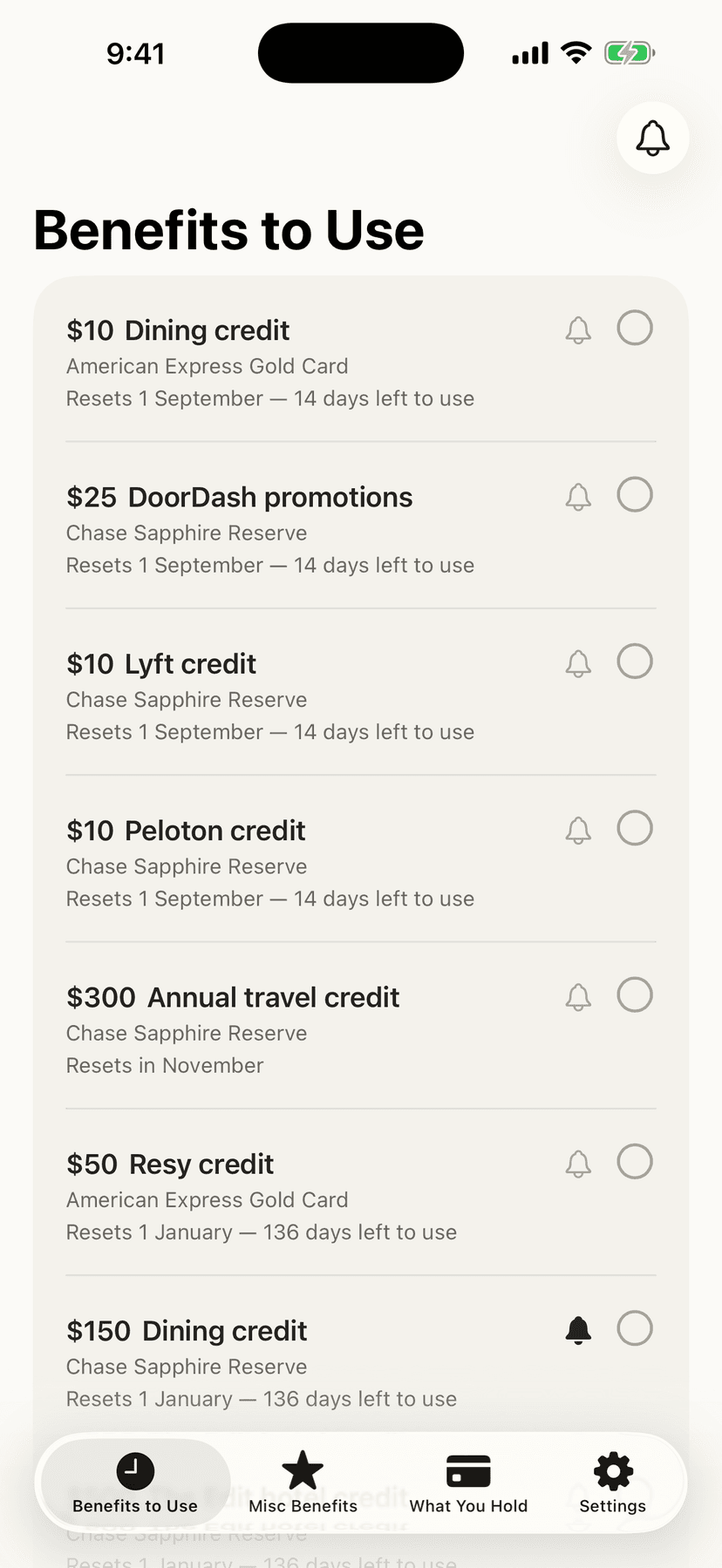
- Every credit attached to the cards you already pay for, in the order they reset.
- No card login, ever. The whole catalogue ships inside the app, and every row is sourced to the issuer.
- Reminders from your own phone before something you have already paid for quietly expires.
Everything it does
Nothing here
no account · no server · no one in between
Nothing here
no account · no server · no one in between
Who this is for
For anyone holding a card with an annual fee and a list of credits attached to it — $15 of Uber Cash that resets every month, $200 of airline fees that resets every year — who has quietly lost some of them by not noticing in time. It needs an iPhone and nothing else.
It will suit you if you want to be told what resets soon and left alone otherwise. It will not suit you if you want an app that reads your accounts and works it out for itself: this one never asks for a card login, never sees a statement, and cannot mark anything used on your behalf. You tell it which cards you hold, and you tap when you have used something.
It will not suit you if you want to be told whether a card is worth keeping. It reports what you used, and stops. It never scores a card, never says a fee pays for itself, and never counts a credit you did not want as money you lost — a $200 airline credit you would not otherwise have spent is not $200.
Nineteen cards and memberships ship with it today, all from large American issuers. There is no way yet to add one that is not on that list, so if yours is missing, this has nothing for you today.
How to set it up
- 01Download it from the App Store and open it. There is nothing to buy, no account to make, and nothing to sign in to.
- 02Add the cards you hold, and say whether you are the primary cardholder or an authorized user on each.
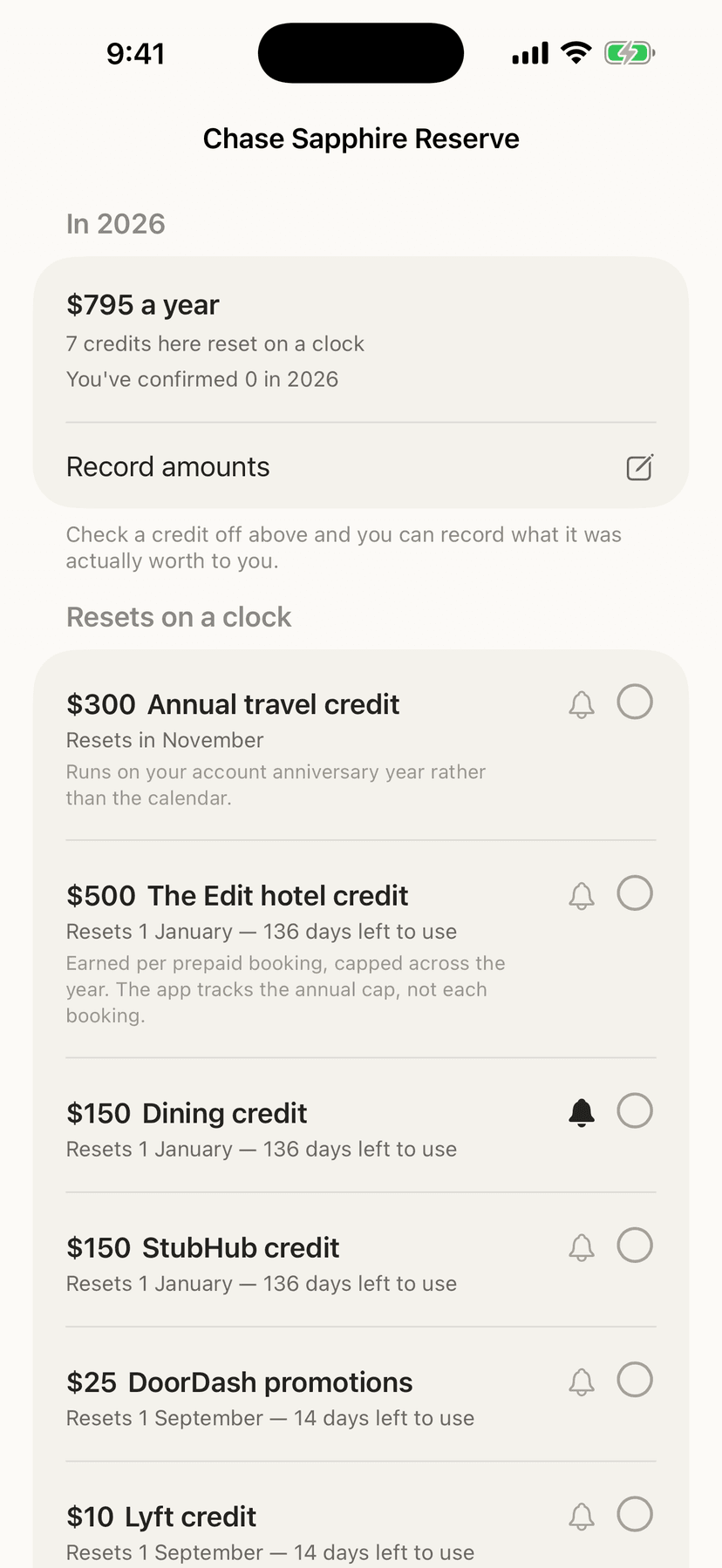
- 03If a card's credits reset on your own account anniversary rather than in January, tell it which month that is. If you don't know it, leave it unset — it leaves those credits out rather than guess a month, and says on the card why they are missing.
- 04Open Benefits to Use. It lists everything that is on a clock, soonest first, with how long is left to use it.
- 05Tap a credit when you have used it. Type the amount if you want it recorded, or leave it blank.
- 06Optionally, put a reminder on the credits you keep forgetting. They arrive from your own phone at 10am, a few days before the credit resets.
What it does
- What resets soon, in order
- The first screen is the credits that are on a clock, soonest first, with how many days are left to use each one. What you have already confirmed drops to a section underneath rather than disappearing, so you can undo it.
- Three kinds of benefit, kept apart
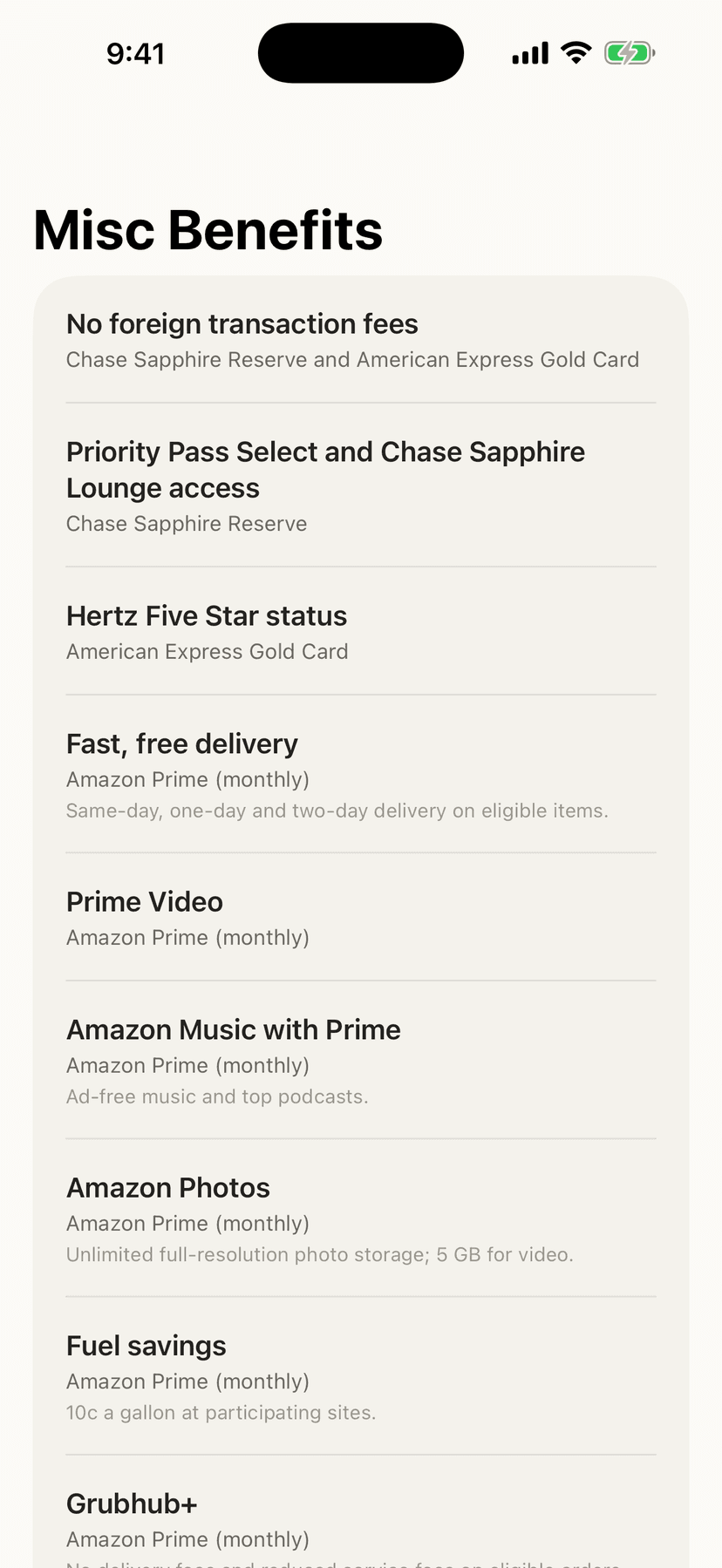
- A credit that resets on a clock is not a lounge membership that is simply always there, and neither is something the app cannot see at all. Collapsing those three is what makes an app like this untrustworthy, so each gets its own place.
- It names what it cannot see
- Every card lists its own blind spots — targeted offers and the like — and says plainly that the app has no view of them. That row costs it the appearance of completeness, and it is the one that should earn the rest of it your trust.
- It never guesses your anniversary month
- Some credits reset on the anniversary of your own account. Until you say which month that is, it leaves those credits out and tells you why. Assuming January reports a credit as live three weeks after it reset — which looks exactly like a correct answer until you lose it.
- It reports what you used, and stops
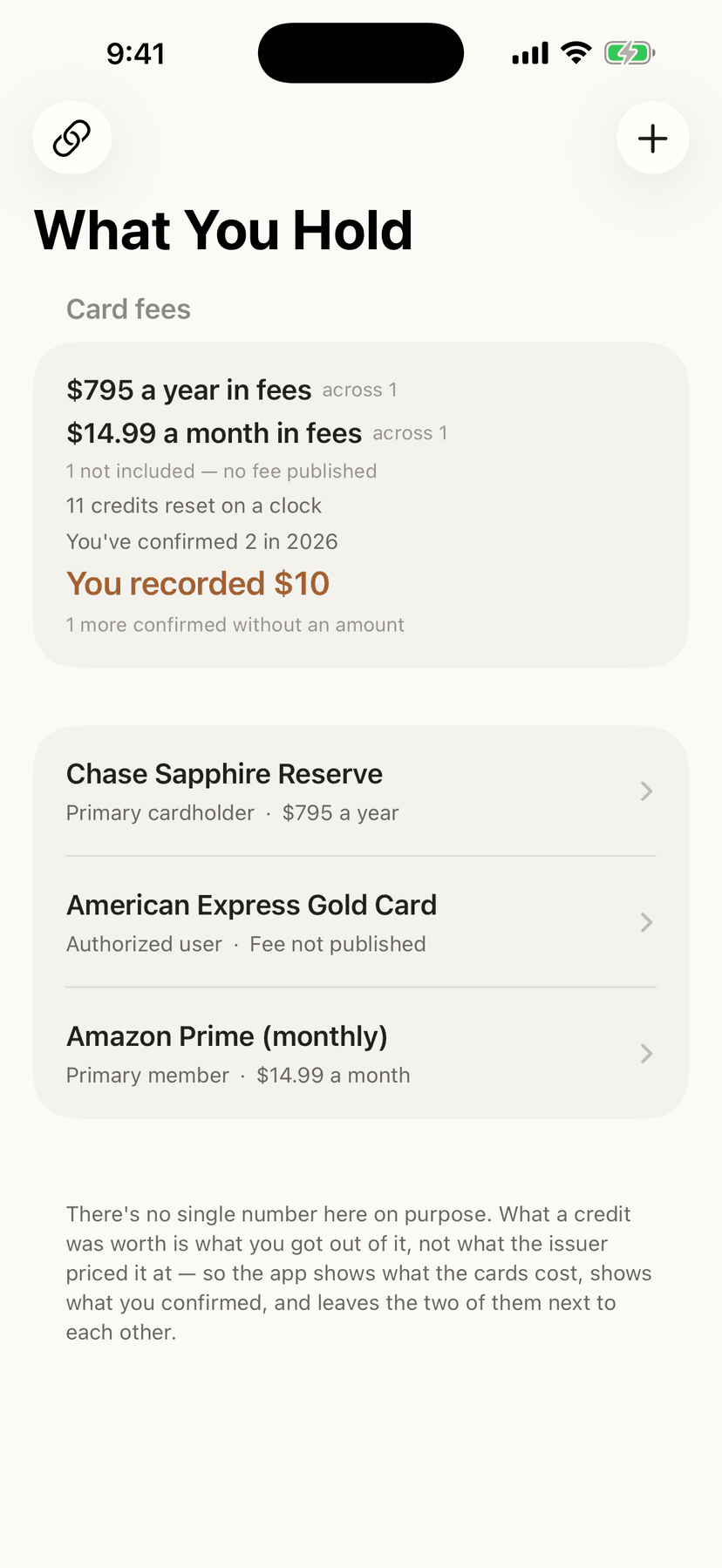
- No net figure, no score, no verdict on whether a card is worth keeping. What you hold puts what the cards cost next to what you confirmed using, and never subtracts one from the other, because pricing a credit you never wanted is the issuer's marketing rather than your position.
- The amount is the one you typed
- If you used $8 of a $15 credit, it records $8 — never the face value out of the catalog. And recording no amount stays a different fact from recording a zero.
- Reminders from your own phone
- One per credit, at 10am, a few days before it resets. They are written on your device and there is no push server. It asks for permission at the moment you turn the switch on, never when the app launches.
- Every row is sourced to the issuer
- Each card carries the issuer's own page as its source and the date somebody last read it. A benefit that could not be sourced that way was left out and the omission written down, rather than filled in from memory or from a blog.
- The whole catalog is inside the app
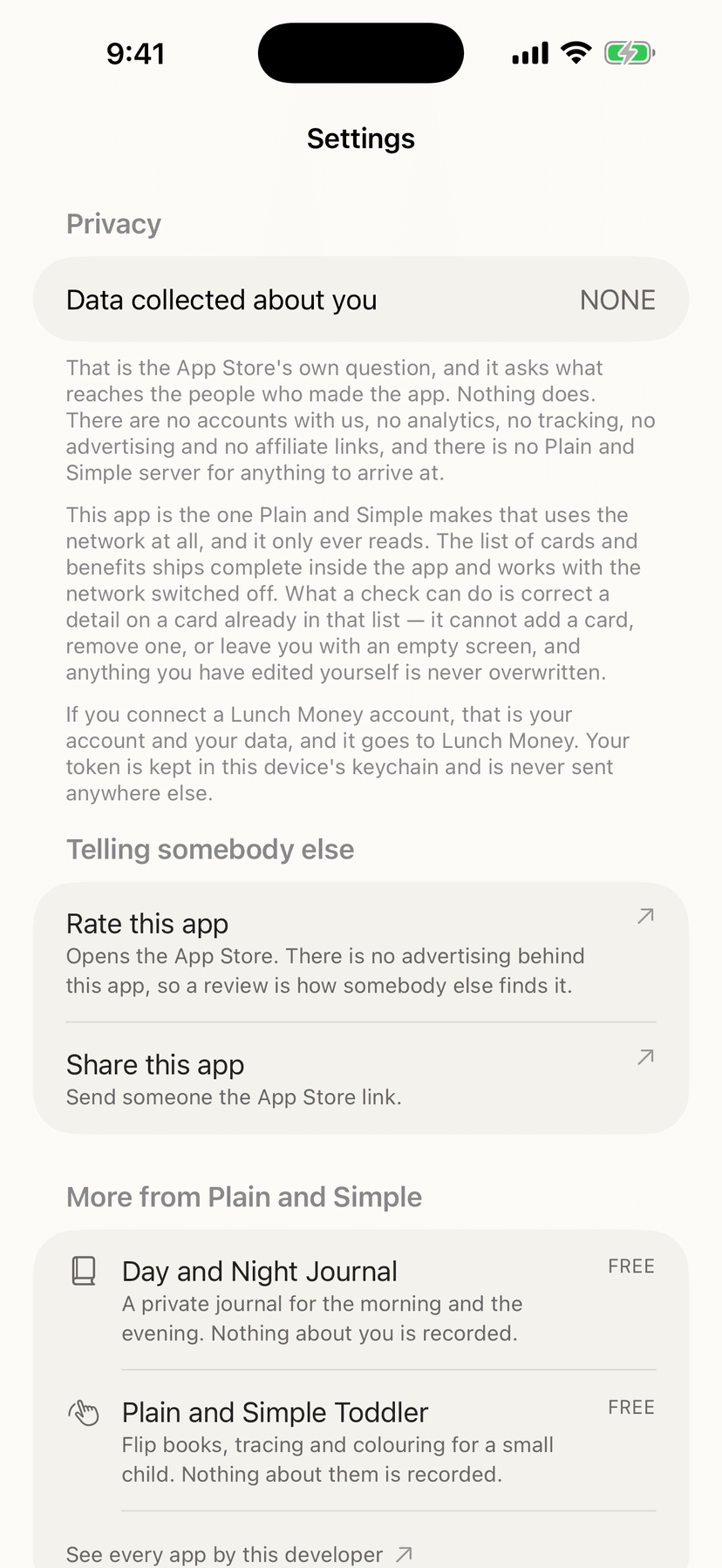
- Every card, every credit and every reset date ships in the app, so it is complete the day you install it and works with no signal at all. Card terms do change, so it can correct a row it already has — it can never add a card, remove one, or be the reason a screen is empty.
- Lunch Money, only if you use it
- If you keep your accounts in Lunch Money, it can read them with a token you issued and point out charges that look like a credit landing. It only ever suggests. Nothing it finds marks anything used, and it writes nothing back.
- Syncs through your own iCloud
- The cards you hold and the credits you confirmed follow you to another iPhone through your own iCloud. There is no account, no server of mine, and nothing to sign into.